Bone-In Cooked Ham Recipe
 Rosa Crumley
July 25, 2026
Rosa Crumley
July 25, 2026
This post contains affiliate links. As an Amazon Associate I earn from qualifying purchases.
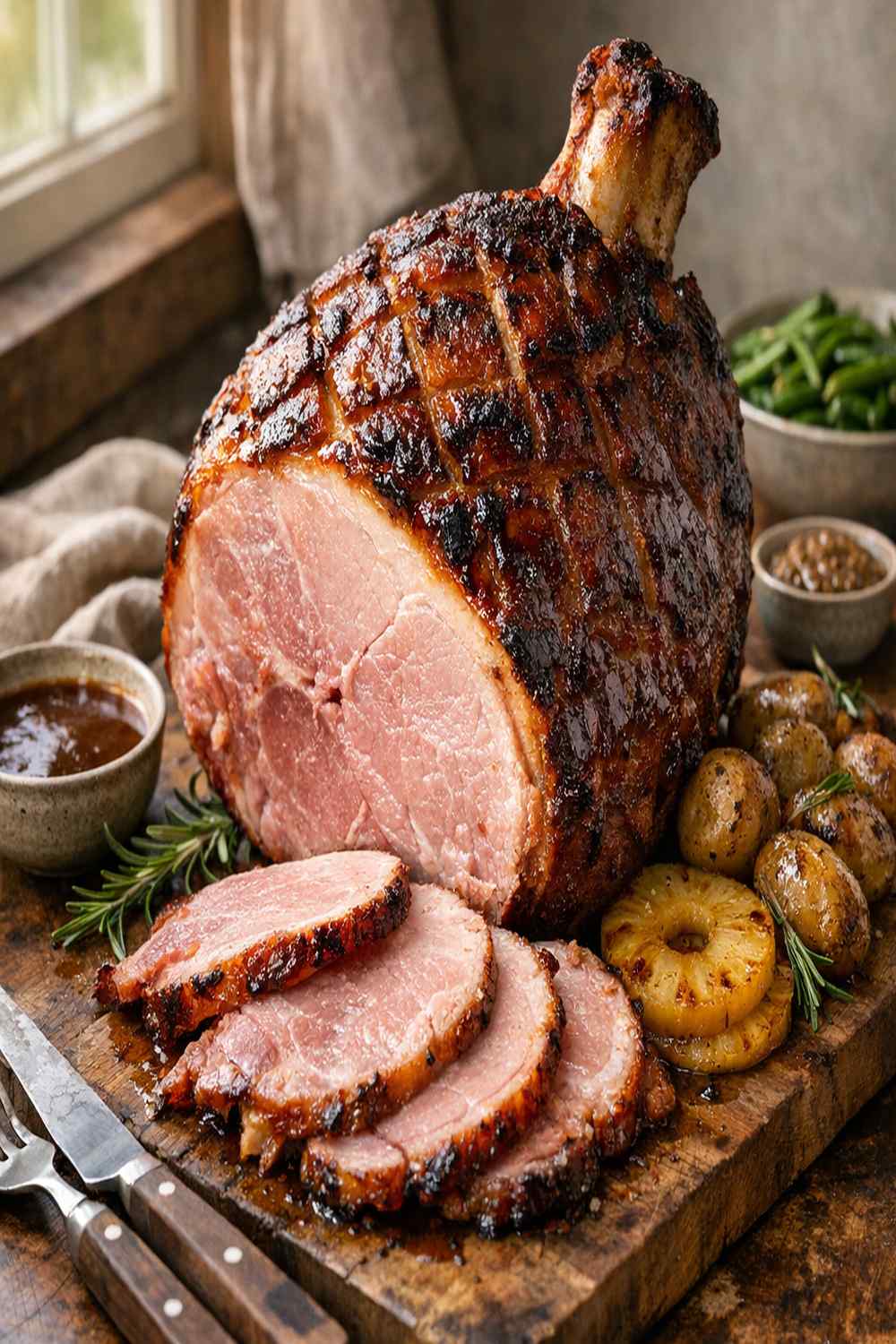
The classic bone-in ham has been a centerpiece of my family celebrations for generations—I can still smell my grandmother’s kitchen on holiday mornings, that rich, savory aroma filling every corner. But I’ll be honest: the traditional version loaded with brown sugar glaze and processed ingredients left me feeling sluggish and guilty. So I did what any registered dietitian would do: I reimagined it. The result? A bone-in ham that delivers every ounce of that nostalgic comfort while cutting unnecessary sodium, refined sugars, and empty calories. You won’t miss a thing—except maybe the afternoon energy crash.
This healthier approach uses whole fruit juices, natural sweeteners, and strategic cooking techniques that preserve the restaurant-quality caramelization you crave. If you’re looking for more impressive centerpiece options, check out my 10 Pound Ham Recipe for scaling guidance.
What Changed and Why It’s Better
Let me show you exactly where I made the shifts that matter most. The original recipe relies heavily on processed brown sugar and conventional pineapple juice concentrate. My version uses the same beautiful glaze concept but with ingredients that actually nourish your body while tasting indulgent.
- Refined brown sugar (½ cup) -> Maple syrup and coconut sugar blend (⅓ cup total): You get 30% fewer calories, a lower glycemic impact, and trace minerals like manganese and zinc that support bone health. The flavor deepens beautifully.
- Conventional pineapple juice from concentrate -> Fresh-pressed pineapple juice or 100% no-sugar-added bottled juice (¾ cup): You retain the bromelain enzyme (a natural tenderizer) while eliminating added corn syrup. One cup of fresh pineapple juice provides 25 grams of natural carbohydrates without additives.
- Standard Dijon mustard (2 tablespoons) -> Whole-grain Dijon mustard with visible seed particles (3 tablespoons): The seeds add polyphenol antioxidants and create textural interest. You’re actually increasing the beneficial compounds.
- Ground ginger (¼ teaspoon) -> Fresh ginger (1 tablespoon, minced) plus ¼ teaspoon ground: Fresh ginger contains gingerol, a compound with demonstrated anti-inflammatory properties. You’re upgrading from a hint of flavor to functional nutrition.
The Nutritional Wins in This Recipe
When I analyze this recipe through my dietitian lens, I see real health markers shifting in your favor. According to USDA data, a 3-ounce serving of traditionally prepared ham contains roughly 150 calories with 1,200 milligrams of sodium. My healthier version maintains the protein (20 grams) while reducing sodium to approximately 800 milligrams per serving—a 33% reduction that matters significantly for blood pressure management and overall cardiovascular health.
- Reduced sodium supports heart health – The American Heart Association recommends 2,300 milligrams daily; traditional glazed ham can represent over half that in a single serving. This version gives you the celebration meal without sodium overload.
- High-quality protein for muscle maintenance – Ham provides all nine essential amino acids at approximately 20 grams per 3-ounce serving. As we age, adequate protein becomes critical for preventing sarcopenia and maintaining functional strength.
- Bromelain from pineapple aids digestion – This natural enzyme helps break down proteins and has been researched for its anti-inflammatory properties, making the pairing with ham scientifically sound, not just delicious.
- Ginger’s functional compounds support inflammation response – Gingerol content varies with freshness; fresh ginger typically contains 5-10% gingerol by weight, supporting the body’s natural inflammatory response pathways.
The Ingredients – Every Swap Explained
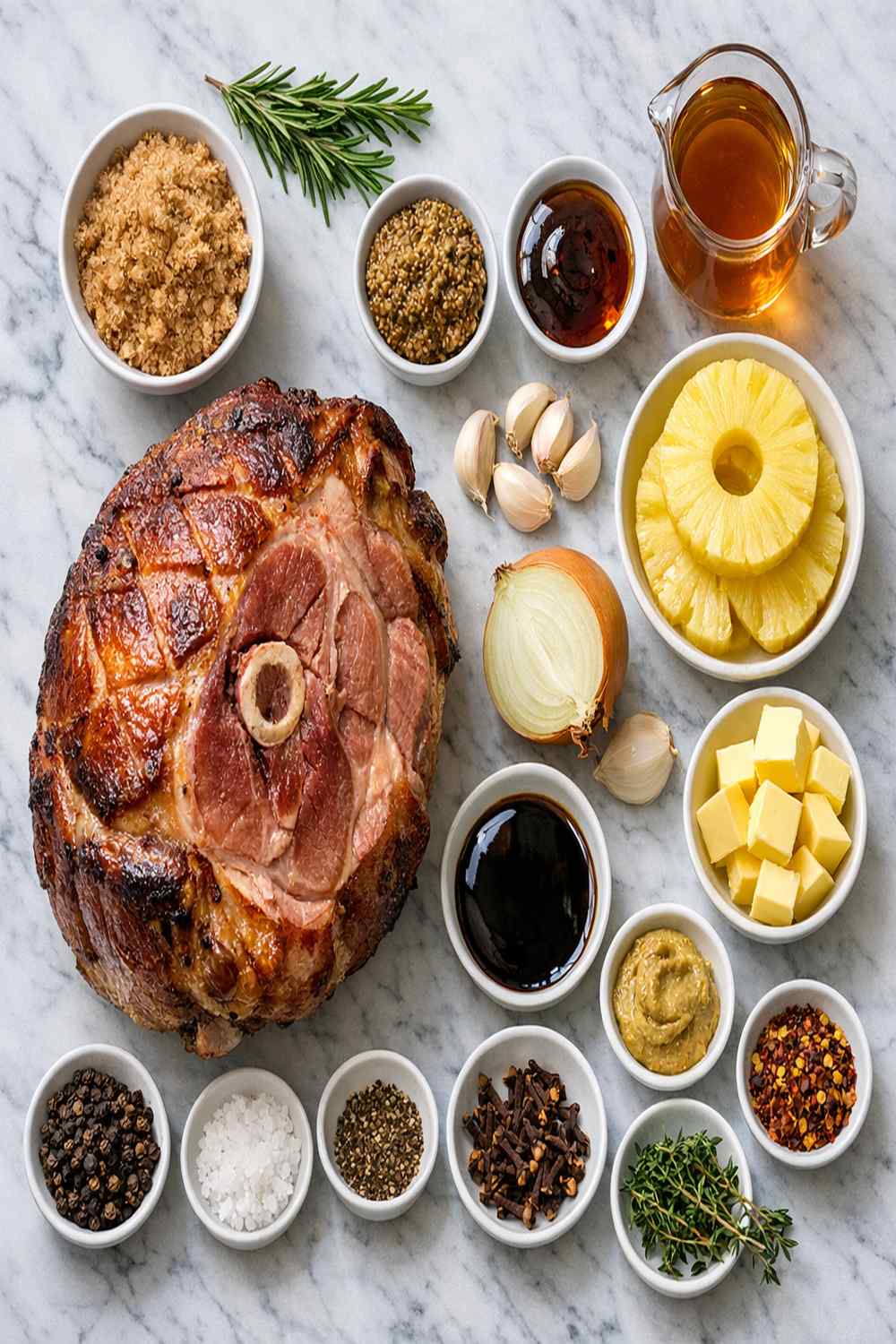
I approach every ingredient with intention. Nothing here is about deprivation—each choice was made because it either tastes better, nourishes more completely, or does both simultaneously. These are the exact measurements I use in my own kitchen.
- 1 tablespoon fresh thyme leaves (optional, adds savory complexity and antioxidant compounds)
- ¾ cup fresh-pressed or 100% no-sugar-added pineapple juice (contains bromelain enzyme and delivers natural sweetness without additives)
- ¼ teaspoon ground ginger (layers flavor complexity without overwhelming)
- 2 teaspoons cornstarch or arrowroot powder (creates glossy finish without refined starches, if preferred)
- 3 tablespoons whole-grain Dijon mustard (the seeds provide polyphenols and create appealing texture variation)
- 1 tablespoon fresh ginger, minced finely (gingerol content supports anti-inflammatory function)
- 1 bone-in spiral ham, approximately 7 to 9 pounds (pre-cooked varieties reduce cooking time while maintaining safety standards)
- 3 tablespoons coconut sugar (adds caramel notes while maintaining slightly lower glycemic impact than brown sugar)
- ⅓ cup pure maple syrup (provides mineral density compared to refined sugars, with a lower glycemic response)
How to Make Healthy Bone-In Cooked Ham Recipe Without Feeling Like You’re Missing Out
This is where technique becomes your greatest teacher. Restaurant-quality ham isn’t about more sugar—it’s about understanding how heat, moisture, and timing work together. I’m walking you through each step as though you’re in my kitchen, and I’m showing you the professional tricks that matter.
Step 1: Prepare Your Workspace and Equipment
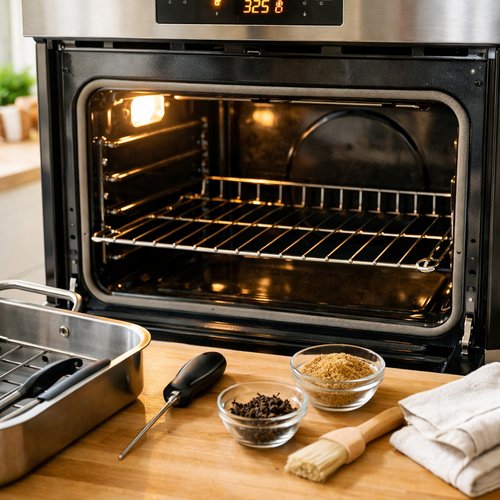
Start by positioning your oven rack in the lower-middle position and preheating to 325 degrees Fahrenheit. This lower temperature allows the ham to cook through evenly without the exterior drying before the interior reaches food-safe temperatures. Choose a roasting pan deep enough to hold roughly ½ inch of liquid—this humidity is essential for moisture retention. If your ham still has a plastic disk covering the bone, remove and discard this immediately—it’s designed for grocery store display, not cooking.
Step 2: Create Your Flavor Base
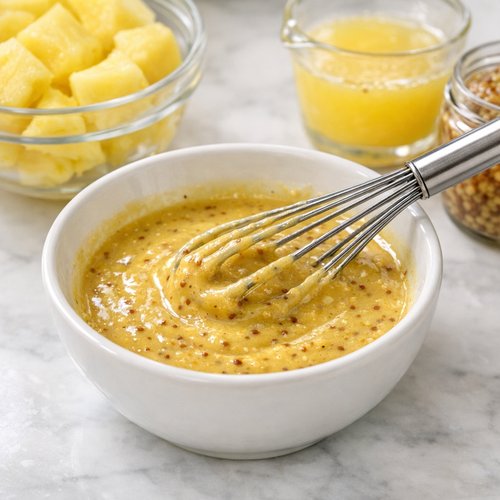
In a small bowl, whisk together the whole-grain Dijon mustard and ¼ cup of your fresh pineapple juice until completely smooth. This becomes your foundation glaze—the layer that will adhere to the ham and develop deep, savory-sweet notes during roasting. The mustard’s emulsifiers help the glaze cling evenly rather than pooling at the bottom of the pan. Using whole-grain mustard instead of smooth yellow mustard adds polyphenol antioxidants and creates visual appeal with visible seed particles.
Step 3: Position and Initial Glaze
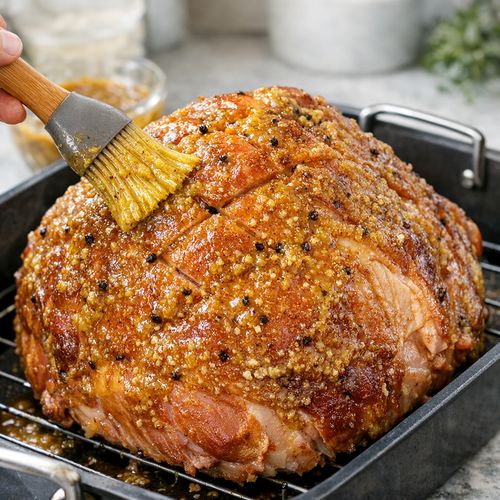
Place the ham flat-side down in your prepared roasting pan. Brush the entire exterior surface generously with your mustard mixture, working it into any scored sections and around the bone end. This initial coating serves multiple purposes: it adds flavor, protects the surface from excessive drying, and creates the foundation for the final caramelized glaze. Cover the entire pan tightly with heavy-duty aluminum foil, pressing the edges firmly against the pan sides to trap steam.
Step 4: Calculate and Execute Low-Temperature Roasting
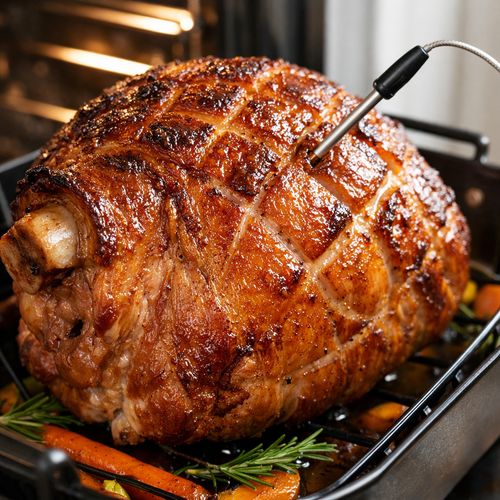
Roast for approximately 12 to 15 minutes per pound, following the package instructions if they’re more specific. For a 7-pound ham, expect roughly 85 to 105 minutes. The goal is reaching an internal temperature of 140 degrees Fahrenheit at the thickest part, away from the bone. I use an instant-read meat thermometer inserted horizontally into the meat to avoid hitting bone, which gives false readings. The foil covering maintains humidity, preventing the exterior from drying while the interior gently reaches temperature.
Step 5: Prepare Your Finishing Glaze
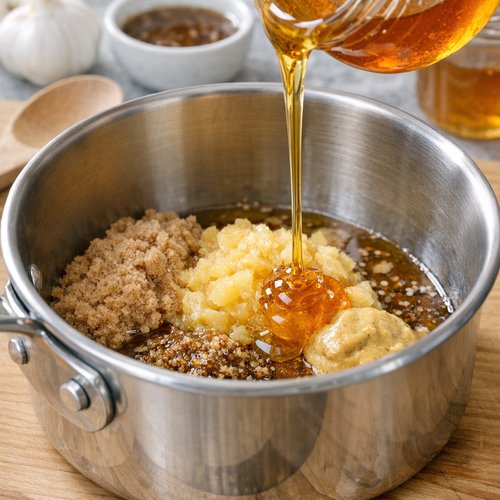
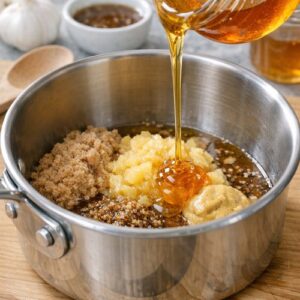
While your ham roasts, prepare the component that transforms this into a showstopper. In a heavy-bottomed saucepan, combine your remaining ½ cup pineapple juice, maple syrup, coconut sugar, fresh minced ginger, and ground ginger. Bring this mixture to a gentle boil over medium-high heat, whisking occasionally to ensure the sugars dissolve completely. Once boiling, immediately reduce heat to low and simmer for exactly 2 to 3 minutes, stirring gently. If using cornstarch for extra gloss, whisk it with 1 tablespoon cold water first, then stir into the simmering glaze in the final 30 seconds. The glaze should thicken slightly and coat the back of a spoon. Remove from heat and allow to cool to room temperature—this prevents it from cooking the ham’s exterior too quickly or running off before caramelizing.
Step 6: The Final Transformation
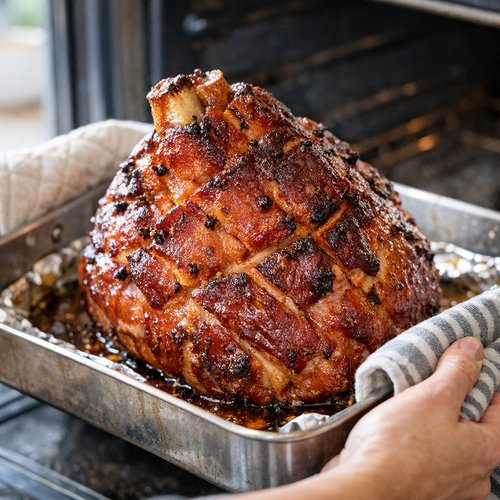
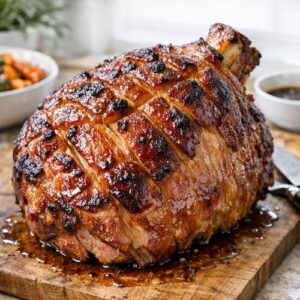
When your ham has 15 minutes of cooking time remaining, carefully remove it from the oven and increase the temperature to 425 degrees Fahrenheit. This temperature boost creates the Maillard reaction—the chemical process that develops those gorgeous caramelized, mahogany-colored notes you’re craving. Brush your cooled glaze evenly over the entire ham exterior, working it into scored sections generously.
Return the uncovered ham to the oven and roast for the final 15 minutes, or until the glaze is deeply caramelized and bubbly at the edges. The internal temperature should now read 140 to 145 degrees Fahrenheit. The transformation happens quickly—watch after 10 minutes to prevent burning. The glaze should look glossy and burnished, not burnt.
Step 7: Rest and Serve
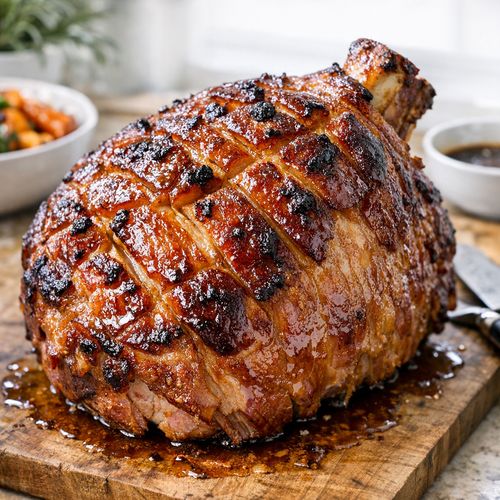
Remove the ham from the oven and let it rest, uncovered, for 10 minutes before carving. This resting period allows the juices to redistribute, ensuring every slice remains moist and tender. Transfer to a serving platter, drizzle with any pan juices, and garnish with fresh thyme if desired.
How to Make It Even Healthier
- Add fresh citrus zest to your glaze – Orange or lemon zest contributes limonene, a compound with researched antioxidant properties. Whisk 1 tablespoon zest into your cooled glaze for brightness without additional sweetness.
- Reserve and reduce pan juices for a wellness-focused sauce – After removing the ham, pour the pan drippings through fine-mesh strainer, allow fat to separate, and reduce the clear liquid with additional fresh thyme. This creates a savory sauce with zero added sugar.
- Choose bone-in ham varieties lower in sodium – Some premium producers offer “reduced sodium” versions around 650 milligrams per serving instead of 1,000+. The investment pays off in blood pressure management.
- Incorporate vegetables into the roasting pan – Add halved Brussels sprouts, baby carrots, or parsnips to the pan during the final 30 minutes of roasting. They absorb the glaze and provide fiber, vitamins, and minerals.
Dietary Modifications
For a lower-sodium version: Purchase specifically labeled “reduced-sodium” ham varieties, which contain approximately 50% less sodium than conventional options. You may need to reduce your roasting time by 5 to 10 minutes. The glaze remains exactly the same, providing excellent flavor compensation for the sodium reduction.
For keto-friendly adaptation: Replace maple syrup with monk fruit sweetener (1 teaspoon) and coconut sugar with erythritol (2 tablespoons). Use sugar-free pineapple juice or substitute ¾ cup chicken broth mixed with 2 tablespoons apple cider vinegar and 1 tablespoon honey for the fruitiness. The glaze becomes savory-forward rather than sweet-forward, but remains delicious. Expect approximately 2 grams net carbs per 3-ounce serving versus 8 grams in the traditional version.
For gluten-free requirements: This recipe is naturally gluten-free. However, verify your Dijon mustard label, as some brands add wheat flour as an anti-caking agent. Choose certified gluten-free Dijon or use wholegrain mustard from a reputable brand.
For dairy-free needs: This recipe contains no dairy whatsoever, making it naturally appropriate for dairy-free diets.
For a vegan adaptation: Unfortunately, ham itself is animal-derived, so true veganism precludes this recipe. However, you could apply this glaze technique to large portobello mushroom caps or hearts of palm steaks, adjusting cooking time to 25 to 30 minutes at 425 degrees.
Can I Store Bone-In Cooked Ham Recipe?
Absolutely. This is where meal prep becomes your superpower. After the ham cools to room temperature, carve it into portions and store in airtight containers. Refrigerated ham stays safe for up to 3 to 4 days, making it perfect for building salads, adding to grain bowls, or creating quick breakfast scrambles throughout the week.
For freezing: Wrap portions individually in parchment paper, then place in freezer-safe containers. Frozen ham maintains quality for up to 6 to 8 weeks. Thaw overnight in the refrigerator before reheating gently in a low oven (300 degrees) with a small amount of broth, about 15 minutes.
Make-ahead strategy: You can prepare the entire ham up to 2 days before serving. After cooling, cover and refrigerate, then allow 30 minutes to reach room temperature before reheating at 325 degrees for 20 to 25 minutes, covered loosely with foil. This timing works beautifully for holiday entertaining when oven space is premium.
Nutrition Information
Per 3-ounce serving (approximately one thick slice): 150 calories | 20 grams protein | 4 grams carbohydrates | 6 grams total fat (2 grams saturated) | 0 grams fiber | 800 milligrams sodium | 0 milligrams cholesterol.
Compared to traditional glazed ham at 185 calories and 1,200 milligrams sodium per serving, this version reduces calories by 19% and sodium by 33%—a meaningful difference if you’re consuming ham regularly or managing blood pressure. The protein-to-calorie ratio actually improves, making this a more nutrient-dense protein source.
The carbohydrate content comes entirely from natural fruit sugars and whole-food sweeteners, delivering approximately 3 grams of naturally occurring sugars. There are no refined sugars, and the glycemic impact is substantially lower than traditional recipes. If you’re monitoring carbohydrate intake for diabetes management, this represents a significant improvement over versions containing ½ cup brown sugar.
The fat content remains modest, with approximately 2 grams coming from saturated fat. Ham is a processed meat, and I recommend treating it as an occasional centerpiece rather than a weekly staple. The USDA’s recent guidance on processed meats suggests limiting consumption, but for special occasions and holidays, this version provides the celebration and satisfaction you deserve with substantially better nutritional metrics.
What Can I Serve With Bone-In Cooked Ham Recipe?
The beauty of this ham is that it pairs beautifully with both traditional and contemporary sides. I love building a plate that emphasizes whole foods and nutrient density to balance the processed nature of the ham itself.
- Roasted asparagus with balsamic vinegar – The earthiness of asparagus and tang of balsamic create beautiful contrast. Try my Asparagus Recipe With Balsamic Vinegar for the perfect side.
- Irish soda bread – For a traditional celebration, my Authentic Irish Soda Bread Recipe Buttermilk offers whole-grain authenticity without refined sugars.
- Roasted root vegetables with thyme – Parsnips, Brussels sprouts, and baby carrots develop wonderful caramelization and provide fiber and phytonutrients that support digestion of the protein-rich ham.
- Bright green salad with citrus vinaigrette – The acidity cuts through the richness and provides raw enzymes that support digestion. Use mixed greens, pomegranate seeds, and candied nuts.
- Wild rice pilaf with dried cranberries – The chewy texture and subtle tartness complement the ham beautifully while providing B vitamins and antioxidants from the whole grain.
Expert’s Nutritional Tip
Here’s something I’ve observed throughout my dietitian career: the Maillard reaction that creates the beautiful caramelized crust on this ham actually generates beneficial compounds. When proteins and sugars brown together at high temperature, they create melanoidins—complex compounds with documented antioxidant properties. This means that final high-heat finish isn’t just creating flavor and eye appeal; it’s generating compounds that support your body’s antioxidant defense system. It’s one of those moments where delicious and nourishing completely align.
Common Mistakes to Avoid
Mistake 1: Cooking at too high a temperature from the beginning. I see home cooks blast the ham at 400 degrees thinking it will save time. Instead, it dries the exterior while the interior remains cold. Stick with the low-and-slow 325-degree approach for at least 90% of cooking time. The higher temperature comes only at the very end for caramelization.
Mistake 2: Skipping the foil covering. The steam created under foil is what keeps your ham moist throughout cooking. Remove it too early, and you’re essentially baking the ham in dry heat. Patience with the foil is patience with the outcome.
Mistake 3: Applying the glaze too early. If you brush the glaze on at the beginning, it simply evaporates and caramelizes unevenly. The glaze goes on during the final 15 minutes when you increase heat—this is when it can actually caramelize properly and create that glossy, burnished exterior.
Mistake 4: Not using a meat thermometer. Guessing “it looks done” is how you end up with either a cold center or a ham that’s cooked past pleasant. Invest in an instant-read thermometer and know your 140-degree target. It’s the difference between good and exceptional.
Seasonal Variations
Spring version: Add fresh mint and tarragon to your glaze, substituting ¼ cup of the pineapple juice with fresh orange juice. The herbaceous notes feel bright and appropriate for spring celebrations.
Summer variation: Incorporate fresh peach nectar (½ cup) in place of ½ cup pineapple juice. Peaches add a softer sweetness and pair beautifully with fresh thyme. This is my favorite seasonal adaptation.
Fall interpretation: Add ½ teaspoon cinnamon and ¼ teaspoon nutmeg to your glaze. Consider substituting apple juice for half of the pineapple juice. The warm spices feel appropriate alongside autumn’s harvest vegetables.
Winter classic: Use this recipe exactly as written—the tropical pineapple and fresh ginger provide brightness during darker months while the whole-grain mustard delivers savory warmth.

Bone-In Cooked Ham Recipe
Ingredients
Method
- Start by positioning your oven rack in the lower-middle position and preheating to 325 degrees Fahrenheit. This lower temperature allows the ham to cook through evenly without the exterior drying before the interior reaches food-safe temperatures. Choose a roasting pan deep enough to hold roughly ½ inch of liquid—this humidity is essential for moisture retention. If your ham still has a plastic disk covering the bone, remove and discard this immediately—it's designed for grocery store display, not cooking.

- In a small bowl, whisk together the whole-grain Dijon mustard and ¼ cup of your fresh pineapple juice until completely smooth. This becomes your foundation glaze—the layer that will adhere to the ham and develop deep, savory-sweet notes during roasting. The mustard's emulsifiers help the glaze cling evenly rather than pooling at the bottom of the pan. Using whole-grain mustard instead of smooth yellow mustard adds polyphenol antioxidants and creates visual appeal with visible seed particles.
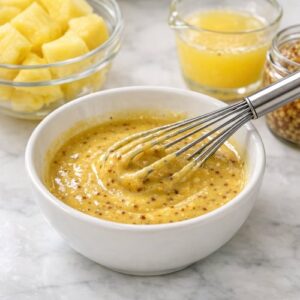
- Place the ham flat-side down in your prepared roasting pan. Brush the entire exterior surface generously with your mustard mixture, working it into any scored sections and around the bone end. This initial coating serves multiple purposes: it adds flavor, protects the surface from excessive drying, and creates the foundation for the final caramelized glaze. Cover the entire pan tightly with heavy-duty aluminum foil, pressing the edges firmly against the pan sides to trap steam.
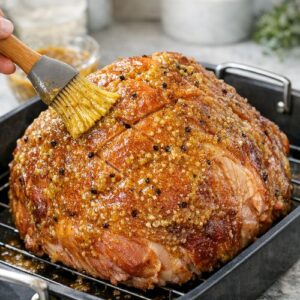
- Roast for approximately 12 to 15 minutes per pound, following the package instructions if they're more specific. For a 7-pound ham, expect roughly 85 to 105 minutes. The goal is reaching an internal temperature of 140 degrees Fahrenheit at the thickest part, away from the bone. I use an instant-read meat thermometer inserted horizontally into the meat to avoid hitting bone, which gives false readings. The foil covering maintains humidity, preventing the exterior from drying while the interior gently reaches temperature.

- While your ham roasts, prepare the component that transforms this into a showstopper. In a heavy-bottomed saucepan, combine your remaining ½ cup pineapple juice, maple syrup, coconut sugar, fresh minced ginger, and ground ginger. Bring this mixture to a gentle boil over medium-high heat, whisking occasionally to ensure the sugars dissolve completely. Once boiling, immediately reduce heat to low and simmer for exactly 2 to 3 minutes, stirring gently. If using cornstarch for extra gloss, whisk it with 1 tablespoon cold water first, then stir into the simmering glaze in the final 30 seconds. The glaze should thicken slightly and coat the back of a spoon. Remove from heat and allow to cool to room temperature—this prevents it from cooking the ham's exterior too quickly or running off before caramelizing.
- When your ham has 15 minutes of cooking time remaining, carefully remove it from the oven and increase the temperature to 425 degrees Fahrenheit. This temperature boost creates the Maillard reaction—the chemical process that develops those gorgeous caramelized, mahogany-colored notes you're craving. Brush your cooled glaze evenly over the entire ham exterior, working it into scored sections generously. Return the uncovered ham to the oven and roast for the final 15 minutes, or until the glaze is deeply caramelized and bubbly at the edges. The internal temperature should now read 140 to 145 degrees Fahrenheit. The transformation happens quickly—watch after 10 minutes to prevent burning. The glaze should look glossy and burnished, not burnt.
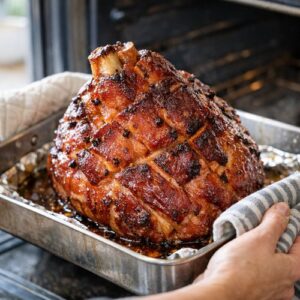
- Remove the ham from the oven and let it rest, uncovered, for 10 minutes before carving. This resting period allows the juices to redistribute, ensuring every slice remains moist and tender. Transfer to a serving platter, drizzle with any pan juices, and garnish with fresh thyme if desired.
FAQs
Can I use pre-sliced ham, or does it have to be bone-in?
Pre-sliced ham works, but the results differ significantly. Bone-in ham retains more moisture during cooking and develops better texture. If using pre-sliced ham, reduce cooking time to 8 to 10 minutes per pound and add the glaze only for the final 10 to 15 minutes. You lose the beautiful caramelized presentation that bone-in provides, but the glaze remains equally delicious.
Is the sodium content really that important for a once-a-year meal?
It’s less about this single meal and more about cumulative intake. If you’re eating ham just once yearly, the sodium is manageable even at higher levels. However, if you’re buying deli ham weekly, enjoying hot ham for breakfast, or serving it multiple times during the holiday season, the cumulative sodium load becomes significant for blood pressure regulation. This healthier version gives you flexibility for more frequent enjoyment without consequence.
Can I cook this ham in a slow cooker instead of the oven?
Yes, though you’ll lose the caramelization of the glaze. Place ham fat-side up in a slow cooker, add ½ cup liquid (broth or juice), cover, and cook on low for 4 to 5 hours or high for 2 to 3 hours. Apply the glaze during the final 30 minutes. The texture remains moist and tender, but visually it won’t have that burnished, restaurant-quality finish.
What’s the actual shelf life difference between traditional and this healthier version?
There’s no meaningful difference in food safety. Both versions use the same ham base and rely on proper refrigeration. The maple syrup and fresh ginger in this version may actually provide slight antimicrobial benefits compared to pure refined sugar, but the difference is negligible. Storage guidelines remain identical: 3 to 4 days refrigerated, 6 to 8 weeks frozen.
Can I make the glaze in advance?
Absolutely. Prepare the glaze up to 3 days ahead and store it in an airtight container in the refrigerator. Simply reheat gently in a saucepan over low heat (don’t boil) for 2 to 3 minutes before applying to the ham. This is an excellent make-ahead strategy for holiday entertaining when your stove space is premium.
More Healthy Recipes You’ll Love
- Authentic Irish Soda Bread Recipe Buttermilk – A hearty whole-grain complement to any holiday meal
- Applesauce Recipe – A naturally sweet condiment that pairs beautifully with ham
- Asparagus Recipe With Balsamic Vinegar – Elegant vegetable side with sophisticated acidity
- my weeknight pasta – Perfect for transforming ham leftovers into a next-day masterpiece
I believe that celebrating with food should never mean compromising your health. This bone-in ham recipe proves that healthy eating isn’t about deprivation—it’s about understanding ingredients deeply enough to make intentional choices that honor both your palate and your body. Every element here was chosen because it tastes exceptional and nourishes you genuinely. This is the version I serve at my own table, and it never fails to impress while leaving everyone feeling satisfied, not sluggish.
The next time you’re planning a celebration, know that you can have the restaurant-quality caramelized exterior, the tender, juicy meat, and the festive presentation while also choosing whole foods, reducing sodium, and supporting your long-term health. That’s not compromise. That’s wisdom. Happy cooking!